When the 10-meter Keck I telescope first became fully operational in 1992, the only planets known to exist were those in our own solar system. Models of planet formation dutifully reproduced the nine known examples, and most astronomers thought that when other planets were finally seen, those solar systems would look like our own, with giant Jovian planets in the outer regions and small rocky planets in the inner parts.

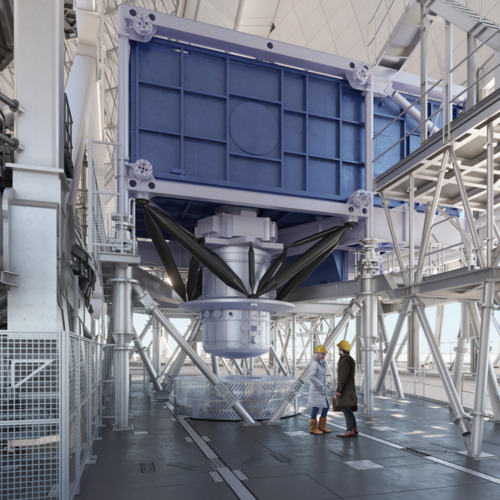
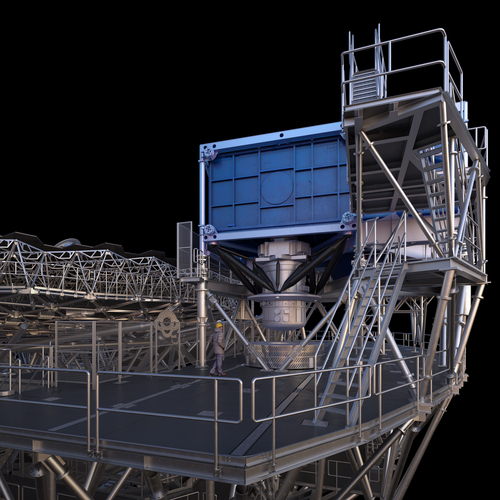
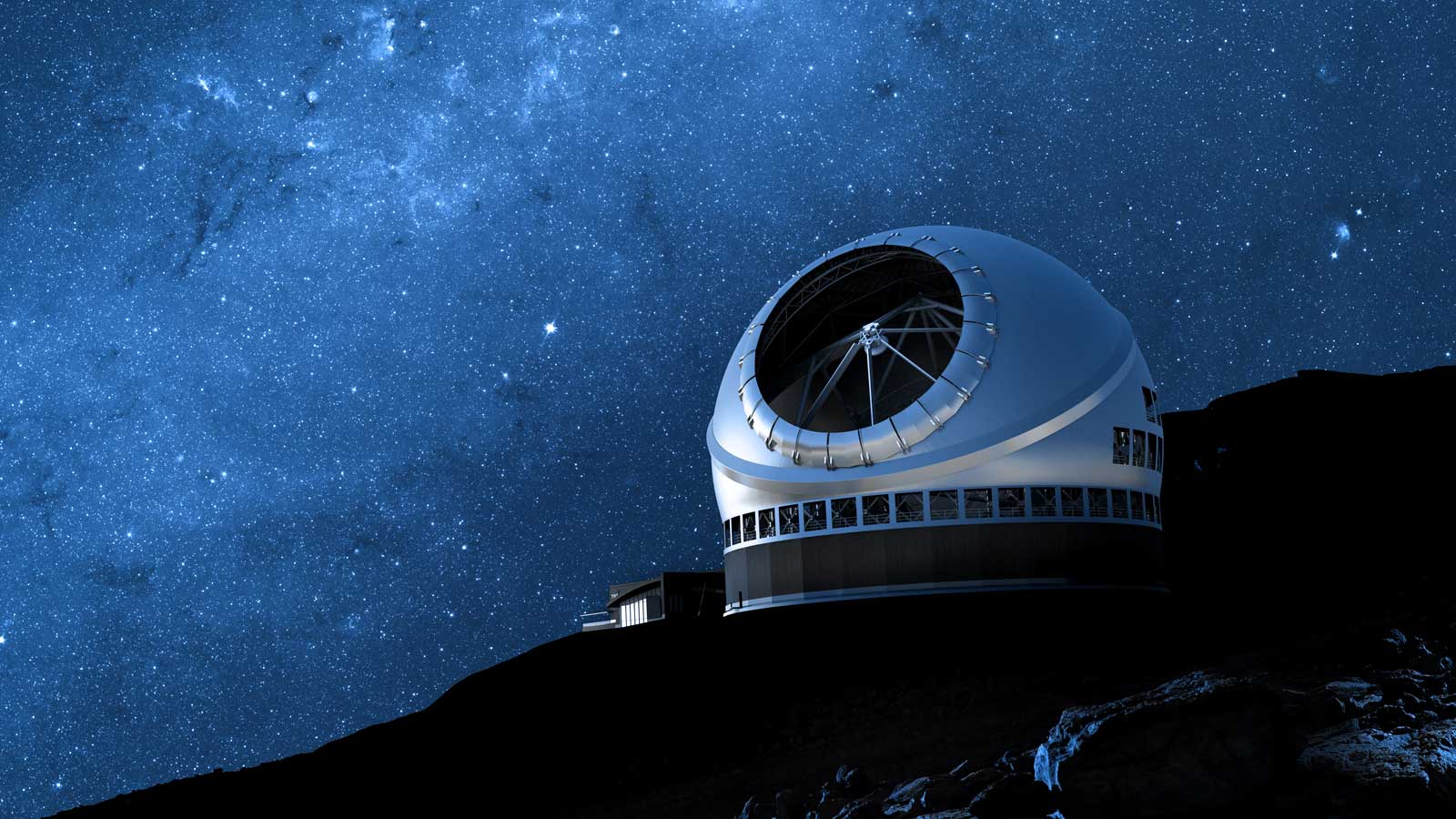
The search for Earth-like planets, the nature and distribution of dark matter, and the quest to image the first stars and galaxies are just some of the science challenges that will be addressed by the Thirty Meter Telescope (TMT).
In the world of scientific research, bigger is often better. This is especially true for astronomy, where giant telescopes are the essential tools for studying the faintest whispers of cosmic energy.
The Thirty Meter Telescope (TMT) marked a major milestone on its way to becoming the world’s most advanced and capable optical telescope. A key part of the telescope’s adaptive optics (AO) system, which will give TMT the sharpest eye possible on the Universe, was successfully tested and is ready to become actual hardware.

Astronomers at the California Institute of Technology (Caltech) and their colleagues used a rare cosmic alignment and modern adaptive optics to image a distant galaxy with similar exquisite resolution promised by the future Thirty Meter Telescope (TMT). This achievement provided detailed insight into the nature of a young star-forming galaxy as it appeared only two billion years after the Big Bang, and determined how that galaxy may eventually...
Displaying news articles 71 - 75 of 75 in total