



LGSF Final Design Review 1 Attendees (LGSF Design Team, Reviewers, and Observers)

LGSF Final Design Review 1 Attendees (LGSF Design Team, Reviewers, and Observers)
The TMT Laser Guide Star Facility (LGSF) team is excited to announce the successful completion of their Final Design Review 1. The review was held at the TIO Project Office on January 21-22, 2026 and included both in-person and remote attendees.
Dr. Gelys Trancho, TIO Project Systems Engineer, chaired the review alongside a panel of expert reviewers. The LGSF team, led by AO Group Leader Corinne Boyer, presented the significant progress made over this final design phase. The design of the optical path, which relays the laser beams from the laser platform to the telescope top-end, was greatly optimized and simplified. Additionally, prototyping efforts were performed for testing the accuracy of Pre-Alignment Cameras and demonstrating performance of actuators and optics at operating temperatures.
The LGSF is responsible for generating artificial laser guide stars that will be used with TMT’s Adaptive Optics (AO) systems. It uses multiple sodium lasers (wavelength of 589 nm) to generate up to four different asterisms that are projected into the sky from the laser launch telescope located behind the TMT secondary mirror. By exciting mesospheric sodium atoms at ~90 km of altitude, the lasers will create artificial stars with the required brightness for providing AO correction to almost any science targets throughout the sky.
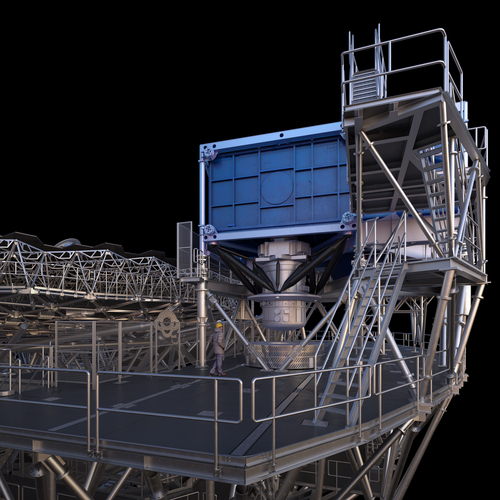
TMT Laser Guide Star Facility mechanical layout - The Laser Units (each consisting of a Laser Head and Laser Electronics) are installed on the laser platform. A long beam transfer optics enables the laser beams to be relayed to the LGSF Top-End, where they will be formatted and then launched from the laser launch telescope - Image credit: TMT International Observatory
The review panel concluded that the LGSF Optical Path is well matured and appropriate for the final design level, with clear operational concepts, strong requirements flowdown, complete and mature interfaces, and a robust compliance and verification framework. The panel commended the design team for the high quality of the design, and the effective risk reduction through prototyping, and a well defined path to address remaining risks in future milestones.
Key recommendations for the final design phase include improving documentation, particularly for operational sequences, alignment procedures, degraded mode and recovery behavior, and second generation of AO instruments interface definition. Additional emphasis should be placed on forming up margins and assumptions related to the vibration budget through prototyping and validation.
The FDR marks a significant progression in the LGSF development, reinforcing our commitment to developing this critical subsystem of the TMT International Observatory. [Funding for this work was awarded to TIO through the U.S. National Science Foundation design and development funding.]
We extend our gratitude to all participants and look forward to continued success as we advance towards the next phase of the LGSF development guided by the valuable feedback from our reviewers.
This material is based upon work supported by the U.S. National Science Foundation under Cooperative Agreement No. 2437863. Any opinions, findings and conclusions or recommendations expressed in this material are those of the author(s) and do not necessarily reflect the views of the U.S. National Science Foundation.
Global Astronomy Community Articulates the Scientific Case for a Northern Hemisphere Extremely Large Telescope
ITCC Stress Mirror Polishing FRR Successfully Completed