
The first Pacific Astronomy and Engineering Education Summit, sponsored by TMT and the County of Hawaii, and hosted at the Imiloa Astronomy Center and the University of Hawaii at Hilo, brought together high school students and educators from China, Japan, India, Canada and the Big Island for four days of intense learning and interaction.

The Thirty Meter Telescope (TMT) project announces today that all of the scientific authorities of the TMT partners have signed a Master Agreement. The Master Agreement document establishes a formal agreement amongst the international parties defining the project goals, establishing a governance structure and defining member party rights, obligations and benefits.

With the sharpest and most sensitive images ever taken in the near infrared, TMT and IRIS will open our eyes to the Universe in exciting new ways, exploring everything from dwarf planets at the orbit of Pluto to the most distant galaxies ever explored near the dawn of cosmic time.
Special Event of the International Symposium on Photoelectronic Detection and Imaging 2011: As part of the 4th International Symposium on Photoelectronic Detection and Imaging (ISPDI 2011), May 24-26, 2011 in Beijing, China, scientists and engineers from the US and China are meeting for a special colloquium on the Thirty Meter Telescope (TMT). The colloquium is a milestone in the TMT international partnership for development and operation of...

The first stars and tiny galaxies formed about 150-300 million years after the Big Bang, 13.7 billion years ago. They were the seeds that led to today’s myriad galaxies, including our own Milky Way. But the details of when and how they developed are still unclear.

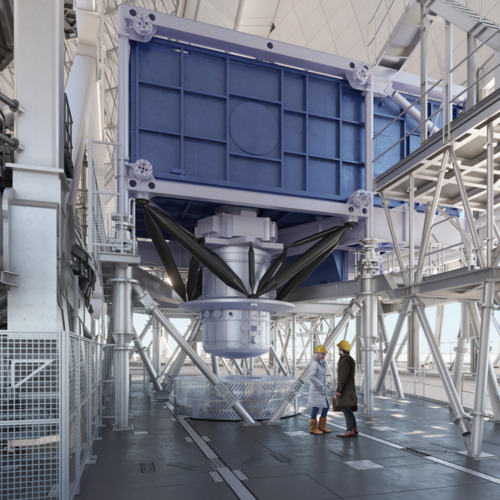
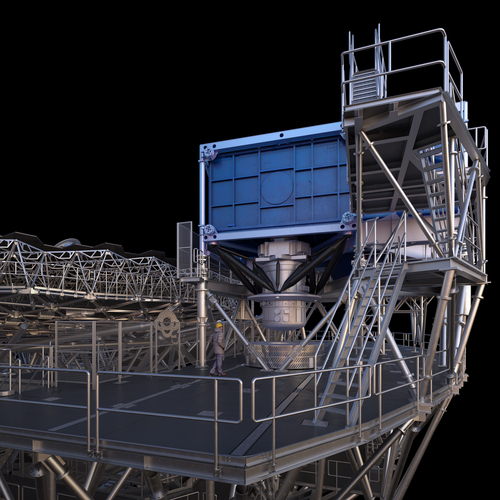
The Thirty Meter Telescope’s (TMT) primary mirror has much in common with the 10-meter mirrors on the Keck telescopes.
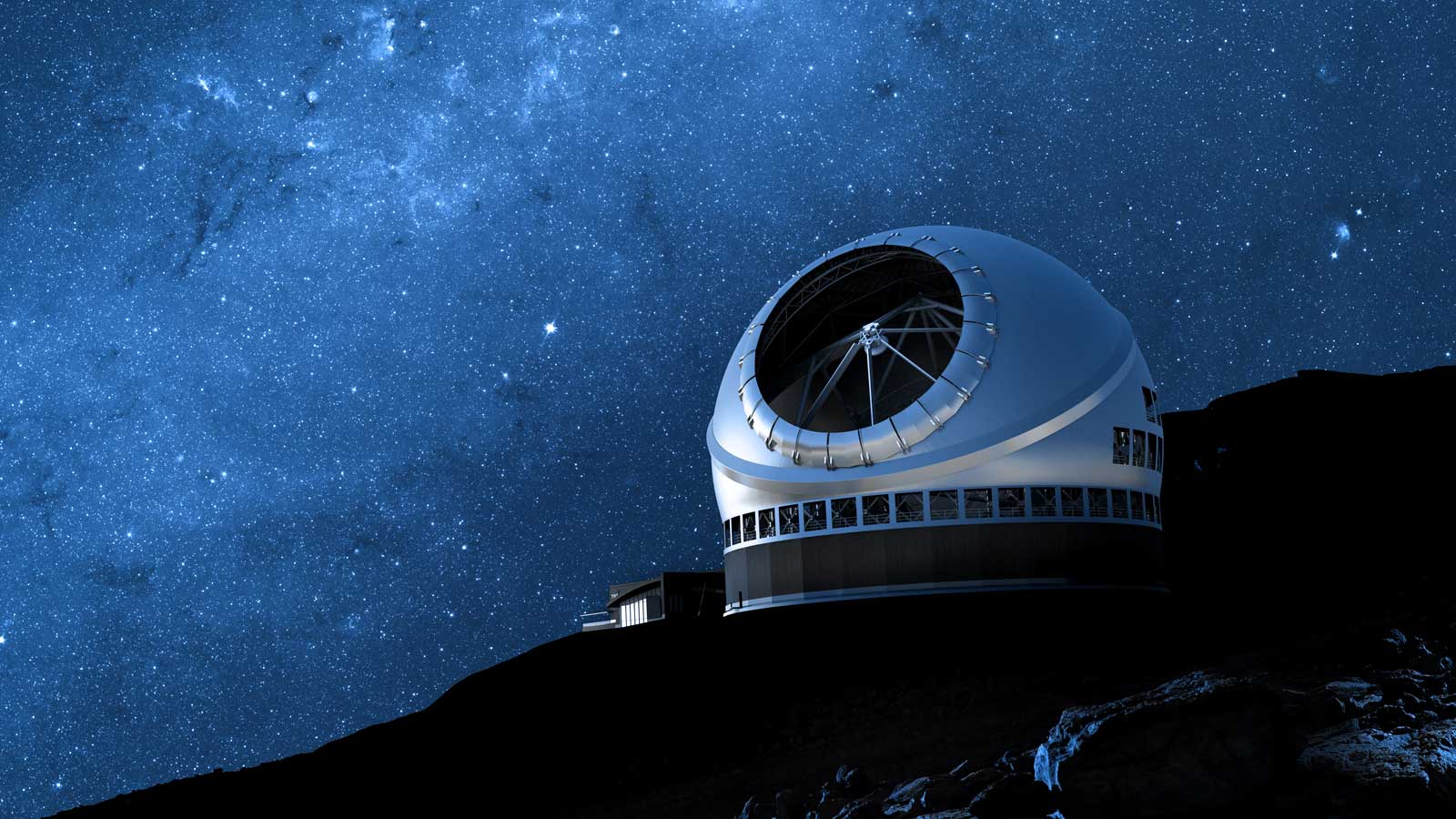
The Thirty Meter Telescope (TMT) will enable astronomers to explore the universe in unprecedented clarity when it achieves “first light” later this decade. The public, however, will get an exciting preview of what TMT will observe as part of the two-day expo for the USA Science and Engineering Festival, October 23 and 24 in Washington, D.C.
On August 13, 2010, the National Academy of Sciences (NAS) released its Astro2010 report, New Worlds, New Horizons in Astronomy and Astrophysics, which indentified a Giant Segmented Mirror Telescope (GSMT) as crucial for ground-based astronomy in the coming decade. The report also recommended that the U.S. National Science Foundation (NSF) immediately select a GSMT partner.
Sometime during the first 300 million years after the Big Bang, the first tiny seeds of galaxies began to collapse and form stars. As these galaxies grew during the subsequent 300–400 million years they ionized the hydrogen gas that permeated the cosmos.
About a hundred experts in astronomy, information technology, and applied computer science have gathered at Caltech to define a new field at the intersection of these disciplines. The emerging field of astroinformatics reflects how science is changing in the 21st century, powered by the information-technology revolution.